|
|
|


|
 |
 HOME>Tennis Court>Structure
|
 |
|
|
|
 |
Tennis Court Facilities |
 |
Surface |
|
Drainage |
|
Fence |
|
Lights |
|
Backboards |
|
Court Accessories/Equipment |
 |
Umpire chairs, net posts, nets, cabanas & awnings, benches, score keepers, etc. |
| |
(Clay court equipment: line cars, rollers, brushes.) |
|
|
|
 |
Surfacing |
|
|
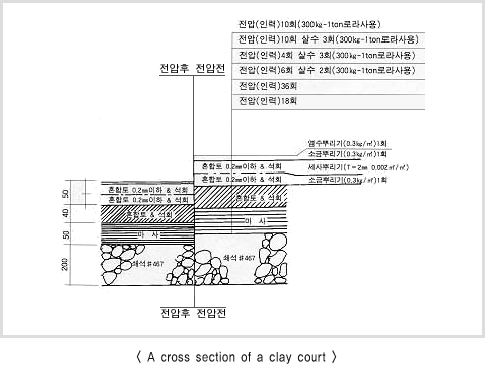
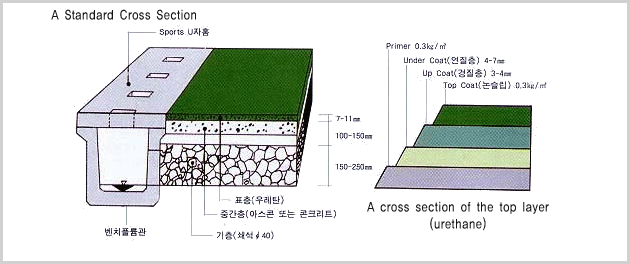
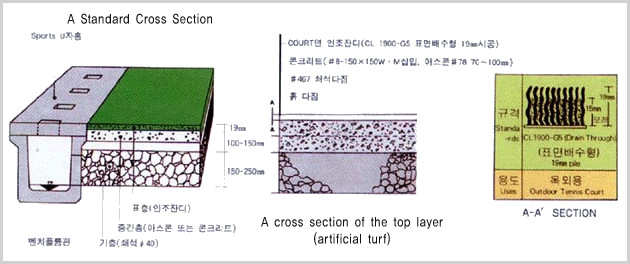
Tennis court surface consists of a crushed stone layer, a middle layer and a surface layer. |
| |
According to surface material, tennis courts are classified into clay courts, urethane courts, and artificial turf courts. |
|
Clay courts are |
|
cheap to construct and topped with mixed natural clay (silt + sand + lime) which allows slip and cushioning, thus protecting players’ ankles and knee-joints. |
| |
susceptible to bad weather and temperature change, so they require careful maintenance. |
|
|
 |
|
|
Urethane courts and artificial turf courts are |
| |
more expensive to construct than clay courts, but playable right after rain, easy to maintain, and comfortable underfoot |
|
 |
 |
|
|
|
Comparison of Tennis Court Surfaces |
|
| Classification |
Clay Courts |
Urethane Courts |
Artificial Turf Courts |
|
Strength
|
- Comfortable underfoot
- Provide optimal slip and
cushioning
- Cheap to construct |
- Playable right after rain
- Low maintenance
- Comfortable underfoot
- Shock absorption
- Various color choices
- No dust |
- Look evergreen
- Low maintenance
- Comfortable underfoot
- Shock absorption
- Partial repair is possible
- No dust |
| Weakness |
- Fast recovery from rain
- Susceptible to weather
change
- High maintenance cost |
- Expensive to construct
- Fast ball bounce |
- Expensive to construct
- Not widespread |
|
|
|
|
 |
Drainage Facilities |
|
|
Surface Drainage |
|
A successfully built court should quickly drain water after rain, and should not form pools on the surface. |
|
The court surface should be slopped with 0.5% angle to allow water run-off. |
|
Drainage ways should be laid along the border of the court to drain water quickly, prevent sand loss, and maintain the surrounding area clean. |
|
Leveling of the entire court surfaces should be done for the surface flatness to prevent the formation of water pools. |
|
Installation of Seepage Drainage (Underground Drainage) for Clay Courts |
| |
Perforated pipes are embedded to help the drainage of water seeping from the surface and its flow underground. |
|
Perforated pipes must be wrapped in geotextile to prevent surface silt and fine sand from contaminating and clogging the pipes. |
| |
In dry seasons, the remaining moisture in the perforated pipes also prevents the surface from drying up. |
|
|
|
 |
Fence Facilities |
|
|
Every material used in fence must be plated with molten zinc and the wire net should be PVC-coated to prevent fence from rusting. |
| |
(To prevent balls from getting stuck between the wires, the wire size should be #10, 50x50 or below.) |
|
The fence height is 3m, and the space between fences should not be 50mm or more not to allow balls to pass through. |
|
Install a regular door(H=2m, W=3m) and an exit (H=2m, W=1m) at the designated area, and fix fence posts with concrete and supporting posts to prepare for bad weather. |
|
|
|
 |
Light Facilities |
|
|
Generally, four light posts are installed per two courts at both sides. |
|
(per one post: 8-10 metal lights of 400W are installed) |
|
As outdoor lighting is exposed to bad weather, it has to be durable and give off even intensity of illumination so as not to interrupt players’ movement.
|
|
For easy maintenance works, footing nuts (10mm) should be installed on the posts at regular intervals. |
|
|
|
|
|