|
|
|


|
 |
 HOME>Futsal Ground>About Futsal
|
 |
|
|
 |
 |
1. What is Futsal?
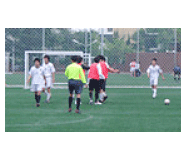
Futsal is an internationally played indoor football, now played by 25 million people around the globe. The five-a-side soccer 'futsal' is played on basketball-sized courts, and the court surfaces come in a variety of types. The rules create an emphasis on improvisation, creativity and technique as well as ball control and passing in small spaces.
|
The origin of Futsal can be traced back to Montevideo, Uruguay, in 1930 when Juan Carlos Ceriani devised a five-a-side version of soccer for youth competition in YMCAs. The game is played on asketball-sized courts, both indoors and out without the use of sidewalls. The term FUTSAL is the international term used for the game. It is derived from the Spanish or Portuguese word for "soccer" -- FUTbol or FUTebol, and the French or Spanish word for "indoor" -- SALon or SALa. Once Ceriani got the ball rolling, Futsal gained rapid popularity throughout South America, particularly in Brazil. The skill developed in this game is visible in the world-famous style the Brazilians display outdoors on the full-sized field. Pele, Zico, Socrates, Bebeto and other Brazilian superstars developed their skill playing Futsal. While Brazil continues to be the Futsal hub of the world, the game is now played, under the auspices of FIFA, all over the world, from Europe to North and Central America and the Caribbean, South America, Africa, and Asia and Oceania. |
|
| |
2. History
The first international competition took place in 1965, when Paraguay won the first South American Cup. Six more South American Cups were held through 1979, with Brazil winning all of them. Brazil continued its dominance with a victory in the first Pan American Cup in 1980 and won it again the next time it was played in 1984.
The first Futsal World Championship conducted under the auspices of FIFUSA was held in Sao Paulo, Brazil, in 1982, with Brazil finishing in first place. The Brazilians repeated as champions at the second World Championship in 1985 in Spain, but lost in the third World Championship in 1988 in Australia to Paraguay.
|
| |
 |
| |
 |
1. The Ball
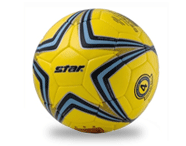
- Felt balls are not permitted for international games. The ball is of a circumference of not less than 62 cm and not more than 64 cm. The ball is not less than 400 grams nor more than 440 grams in weight at the start of the game.
- The ball may not bounce less than 50 cm nor more than 65 cm on the first rebound when dropped from a height of 2 m.
- In FIFA competition games, and in competition games organized under the auspices of the confederations, acceptance of a ball for use is conditional upon the ball bearing one of the following three designations: The official “FIFA APPROVED” logo or - The official “FIFA INSPECTED” logo or - The reference “INTERNATIONAL GAME BALL STANDARD” Such a designation on a ball indicates that is has been tested officially and found to be in compliance with specific technical requirements, different for each category and additional to the minimum specifications mentioned above. The ball may not be changed during the game without the permission of the referee.
|
|
2. Number of Players |
- A game is played by two teams, each consisting of no more than five players, one of whom is the goalkeeper. At the start of a game, each team must have a minimum of five players. If, in the event of players being sent off, fewer than three players (including the goalkeeper) are left in either of the teams, the game must be abandoned.
- Substitutes may be used in any game played under the rules of an official competition at FIFA, confederation or national association level.
- The maximum number of substitutes permitted is seven.
- The number of substitutions made during a game is unlimited. A player who has been replaced may return to the playing court as a substitute for another player.
- A substitution is one which is made when the ball is in or out of play and for which the following conditions are observed:
- the player leaving the playing court must do so at his own substitution zone.
- the player entering the playing court must also do so at his own substitution zone but not until the player leaving the playing court has passed completely over the touchline.
- a substitute is subject to the authority and jurisdiction of the referees whether called upon to play or not.
- the substitution is completed when the substitute enters the playing court, from which moment he becomes a player and the player whom he is replacing ceases to be a player.
- A goalkeeper may change places with any other player.
|
3. Infringements / Sanctions |
- the infringement of the rule 6 does not stop the play.
- If, while a substitution, is being made, a substitute enters the playing court before the player being replaced has completely left:
- play is stopped
- the player being replaced is instructed to leave the playing court
- the substitute is cautioned and shown the yellow card
- play is restarted by an indirect free kick to be taken by the opposing team from the place where the ball was situated when the game was stopped. However, if the ball was inside the penalty area, the indirect free kick is taken from the penalty area line, at the place nearest to the position of the ball when play was stopped.
- If, while a substitution, is being made,, a substitute enters the playing court or a player being replaced leaves it from a place other than the substitution zone:
- play is stopped
- the offending player is cautioned and shown the yellow card
- play is restarted by an indirect free kick to be taken by the opposing team from the place where the ball was situated when the game was stopped. However, if the ball was inside the penalty area, the indirect free kick is taken from the penalty area line, at the place nearest to the position of the ball when play was stopped.
|
4. Players’ Equipment
- A player must not use equipment or wear anything which is dangerous to himself or another player
- The basic compulsory equipment of a player is a shirt, shorts, socks, shin-guards, and footwear
footwear - the only types of footwear permitted are canvas or soft-leather training or gymnastic shoes with soles of rubber or a similar material. The use of footwear is compulsory
Shin-guards
- are covered entirely by the socks
- are made of a suitable material (rubber, plastic or similar substances)
- provide a reasonable degree of protection
Goalkeepers
- the goalkeeper is permitted to wear long trousers
- each goalkeeper wears colors which easily distinguish him from the other players and the referees
- Infringements/Sanctions
For any Infringement of this Law, the player at fault is instructed by the referee to leave the playing court to correct his equipment or to obtain any missing item of equipment. The player may not return to the playing court without first reporting to one of the referees, who then checks that the player’s equipment is now correct. The player is only allowed to re-enter the game when the ball is out of play. |
| Refefence: http://www.futsal.org |
|
|
|
|